


Corns – What Are They and How Can I Prevent or Remove Them?

Corns are localized areas of thickened skin that develop as a protective response to repeated pressure or friction.
They most commonly appear on the feet, particularly over bony areas such as the tops of toes, between toes, and weight-bearing points on the soles.
Although corns are not medically dangerous, they can become painful, interfere with walking, and affect daily comfort when pressure continues.
Many individuals attempt to trim or scrape corns repeatedly, only to find that they reappear. This recurrence often leads to interest in more structured approaches, such as homeopathic medicine for corn, particularly when the goal is gradual softening and reduction without aggressive intervention.
Understanding why corn forms and why they return is essential before deciding on management.
This article explores the structure of corn, the mechanical causes behind it, prevention strategies, and how corn treatment in homeopathy is traditionally approached.
What Is Corn? Understanding the Skin Response
A corn is a localized thickening of the outermost layer of the skin, known as the stratum corneum.
This thickening occurs through a process called hyperkeratosis, where excess keratin accumulates as a defense mechanism.
When the skin experiences repeated friction or pressure, it adapts by increasing keratin production. Initially, this appears as mild thickening.
Over time, if the pressure continues, the thickened layer becomes compacted into a dense central core. This core presses inward toward deeper tissues, which explains why corns may cause discomfort during walking or standing.
Unlike calluses, which are broad and spread out, corns are:
-
Small and circular
-
Clearly demarcated
-
Hard and dense
-
Often painful under direct vertical pressure
They are commonly located in areas where bones lie close to the surface, and cushioning is minimal.
Why Do Corns Develop?
Corns are fundamentally mechanical in origin. They are not infections, nor are they contagious. They represent the body’s attempt to protect deeper tissues from chronic stress.
Several mechanical and structural factors contribute to their development.
1. Ill-Fitting Footwear
Shoes that are tight, narrow, or poorly padded create concentrated pressure points. High heels shift body weight forward, increasing pressure on the toes and forefoot. Over time, repeated compression in these areas leads to keratin buildup.
2. Abnormal Foot Structure
Toe deformities such as hammertoes, bunions, or claw toes alter the way pressure is distributed during walking. Flat feet or high arches may also create uneven load-bearing zones, increasing stress in specific areas.
3. Gait Abnormalities
Imbalances in walking patterns, even subtle ones, can repeatedly stress the same part of the foot.
4. Repetitive Friction
Athletes, runners, or individuals who stand for long periods may experience continuous friction, especially if footwear lacks proper support.
When these forces remain uncorrected, the skin continues to thicken defensively. Surface trimming may reduce thickness temporarily, but unless pressure is relieved, the cycle repeats.
Types of Corns
Understanding the type of corn can influence management.
1. Hard Corns
Hard corns are dry, firm, and usually located on the tops or sides of toes. They are commonly associated with tight footwear. Because they press directly against bone, they often cause significant discomfort.
2. Soft Corns
Soft corns develop between toes where moisture accumulates. Constant friction combined with sweating causes them to appear whitish and softer. They may be painful due to skin maceration.
3. Seed Corns
Seed corns are small and often found on the sole. They may not always be painful, but can create a sensation of something embedded in the skin.
Corn vs Callus vs Wart: Understanding the Difference
Accurate identification is essential before beginning corn homeopathic medicine.
Corn
-
Caused by mechanical pressure
-
Has a defined central core
-
Painful when pressed directly downward
-
Does not spread
Callus
-
Diffuse thickening
-
Usually painless
-
Caused by repeated friction
-
Common on soles
Wart
-
Caused by a viral infection
-
May show small black dots
-
Can spread
-
Often painful when squeezed from the sides
Misidentifying a wart as a corn may delay proper care.
Who Is at Higher Risk?
Certain individuals are more prone to developing corn.
-
People who regularly wear narrow or tight shoes
-
Individuals with foot deformities
-
Elderly individuals with reduced natural cushioning
-
Athletes or long-distance walkers
-
Individuals who walk barefoot on hard surfaces
Special caution is required in individuals with diabetes or circulatory disorders, as improper trimming may cause complications.
Why Corns Recur
Recurrence is common because:
-
The underlying pressure source remains
-
Footwear habits are unchanged
-
Structural abnormalities are not corrected
-
Only the surface thickness is removed
Without addressing mechanical stress, the skin continues to defend itself by thickening.
Preventing Corn Formation
Prevention focuses on eliminating chronic friction.
Proper Footwear Selection
Shoes should:
-
Provide sufficient toe space
-
Avoid tight fronts
-
Offer cushioning
-
Allow natural toe movement
Protective Padding
Silicone toe caps or separators reduce friction between toes.
Regular Inspection
Early identification of thickening allows timely intervention.
Structural Correction
Orthotic inserts may redistribute weight more evenly.
Preventive measures reduce recurrence and dependence on repeated trimming.
Homeopathy for Corn treatment and removal
Homeopathy medicine for foot corn focuses on supporting the gradual normalization of thickened tissue rather than abrupt removal.
The objectives of corn treatment in homeopathy include:
-
Encouraging gradual softening
-
Reducing excessive keratin buildup
-
Supporting tissue balance
-
Addressing recurrence tendency
Remedy selection depends on the lesion’s hardness, depth, recurrence pattern, and associated skin characteristics.
Best Homeopathic Remedies for Corn
In corn treatment in homeopathy, remedy selection is not based merely on the presence of thickened skin.
The nature of the corn, its depth, recurrence pattern, associated skin texture, and mechanical background all influence remedy choice.
The aim is not aggressive removal but gradual softening and reduction of the hyperkeratotic core while addressing the tendency for recurrence.
The following remedies are traditionally referenced in homeopathy medicine for foot corn.
1. Antimonium Crudum
Antimonium Crudum is strongly associated with thick, hard, hyperkeratotic skin conditions. It is frequently considered when the corn is dense, well-defined, and painful under direct pressure.
This remedy may be particularly relevant when:
-
The corn is dry, hard, and prominently raised
-
There is significant thickening of the surrounding skin
-
Walking aggravates discomfort
-
The skin appears rough or calloused in multiple areas
Antimonium Crudum is often referenced in cases where the skin demonstrates a strong tendency toward excessive keratin buildup in response to friction. It aligns with mechanical hyperkeratosis that develops gradually and becomes compact over time.
2. Calcarea Fluorica
Calcarea Fluorica is traditionally associated with hardened, fibrous tissue and structural rigidity. It is considered when the corn feels deeply rooted rather than superficial.
This remedy may be relevant when:
-
The corn appears firmly embedded
-
The surrounding tissue feels hard or inflexible
-
Recurrence is frequent despite trimming
-
There are underlying structural deformities contributing to pressure
Calcarea Fluorica is often discussed in chronic cases where tissue elasticity is reduced and the lesion feels resistant to superficial measures. It aligns with long-standing corns that repeatedly reform at the same site.
3. Thuja Occidentalis
Thuja Occidentalis is commonly referenced in cases where differentiation between corn and wart is unclear or when the lesion shows proliferative characteristics.
It may be considered when:
-
The lesion has irregular margins
-
The surface appears uneven or slightly elevated
-
There is a history of recurrence
-
The growth resembles a wart-like structure
Thuja is traditionally associated with abnormal localized skin proliferation. In corn homeopathic medicine, it is often considered when the lesion demonstrates a tendency to persist or reappear despite pressure reduction.
Best Homeopathic Medicine for Corn
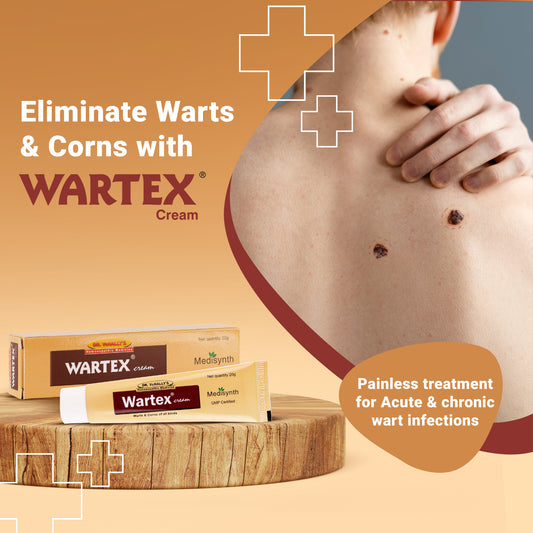
Wartex Cream by Medisynth
Wartex Cream is formulated for localized skin growths such as corn and warts. It incorporates traditionally referenced homeopathic ingredients associated with thickened tissue support.
It is commonly considered when:
-
Corns are persistent
-
Recurrence is frequent
-
Gradual softening is preferred
-
Localized topical support is desired
Wartex Cream complements preventive measures within structured homeopathy medicine for corn management.
When to Seek Professional Help
Medical consultation is recommended if:
-
Pain becomes severe
-
Redness or discharge appears
-
You have diabetes
-
Circulation issues are present
Frequently Asked Questions
1. How long does corn homeopathic medicine take to show results?
Results vary depending on duration, depth, and whether mechanical stress has been addressed. Superficial corns may soften gradually over weeks, while deeply rooted or recurrent corns require longer-term management.
2. Can homeopathy medicine for corn prevent recurrence?
Recurrence prevention depends primarily on eliminating friction and pressure. However, corn homeopathic medicine is traditionally used to address the tendency toward excessive keratinization, which may reduce the frequency of recurrence when combined with proper footwear and foot care.
3. How do I know if my corn is actually a wart?
Corns are caused by mechanical pressure and are painful when pressed directly downward. Warts are viral in origin and may show small black dots within the lesion. They are often painful when squeezed from the sides.
4. Can I combine mechanical removal with homeopathic medicine for corn?
Yes. Professional trimming may reduce thickness and pain, but without addressing recurrence tendency and pressure correction, the lesion may reform.
Conclusion
Corns are localized thickened skin responses to repeated mechanical stress. Although not dangerous, they may cause discomfort and recurrence if underlying pressure remains unaddressed.
Combining preventive footwear practices with homeopathic medicine for corn offers a structured approach focused on gradual softening and recurrence reduction. Homeopathic remedies such as Wartex Cream complement mechanical correction within balanced corn management.
References:
Featured Collection

- MRP: ₹ 194.00 (Incl. of all taxes)
-
₹ 200.00 - MRP: ₹ 194.00 (Incl. of all taxes)
- Unit price
- per
- MRP: ₹ 194.00 (Incl. of all taxes)
-
₹ 200.00 - MRP: ₹ 194.00 (Incl. of all taxes)
- Unit price
- per
- MRP: ₹ 206.00 (Incl. of all taxes)
-
₹ - MRP: ₹ 206.00 (Incl. of all taxes)
- Unit price
- per
- MRP: ₹ 206.00 (Incl. of all taxes)
-
₹ - MRP: ₹ 206.00 (Incl. of all taxes)
- Unit price
- per


- MRP: ₹ 374.00 (Incl. of all taxes)
-
₹ - MRP: ₹ 374.00 (Incl. of all taxes)
- Unit price
- per
- MRP: ₹ 374.00 (Incl. of all taxes)
-
₹ - MRP: ₹ 374.00 (Incl. of all taxes)
- Unit price
- per
- MRP: ₹ 200.00 (Incl. of all taxes)
-
₹ - MRP: ₹ 200.00 (Incl. of all taxes)
- Unit price
- per
- MRP: ₹ 200.00 (Incl. of all taxes)
-
₹ - MRP: ₹ 200.00 (Incl. of all taxes)
- Unit price
- per
- MRP: ₹ 160.00 (Incl. of all taxes)
-
₹ - MRP: ₹ 160.00 (Incl. of all taxes)
- Unit price
- per
- MRP: ₹ 160.00 (Incl. of all taxes)
-
₹ - MRP: ₹ 160.00 (Incl. of all taxes)
- Unit price
- per